The Last Code Review: Why AI Is Making Human Code Review Obsolete
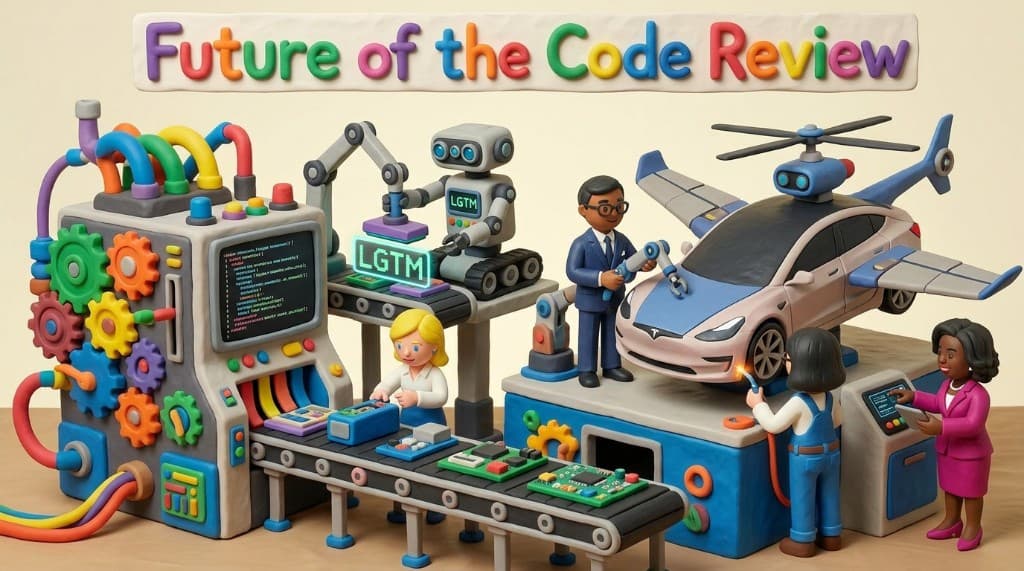
The Last Code Review: Why AI Is Making Human Code Review Obsolete
And why that's not the reckless idea it sounds like.
I remember the exact moment I stopped believing in human code review.
It was a Thursday afternoon, and I was reviewing a 400-line pull request from a colleague. I'd been staring at it for forty minutes. I left three comments: a nitpick about naming, a suggestion to extract a helper function, and a question about an edge case that turned out to be handled two files away. I approved it.
Two weeks later, that PR caused a production incident. The bug was right there in the diff — a subtle race condition in a caching layer. I had looked directly at it and seen nothing.
I wasn't lazy. I wasn't unqualified. I was human. And humans are, it turns out, spectacularly bad at the thing we've built an entire engineering ritual around.
The uncomfortable truth about code review
Let's be honest about what most code review actually is: a tired engineer, context-switching away from their own work, skimming a diff they didn't write, in a codebase region they may not know well, under social pressure to not be "that reviewer" who blocks everything.
Research has told us for years that review effectiveness collapses after about 200–400 lines of code and 60 minutes of attention. Beyond that, we're not reviewing — we're performing review. We're rubber-stamping with extra steps.
Meanwhile, the actual value we get from human review has been quietly migrating elsewhere:
- Style enforcement? Linters and formatters took that a decade ago.
- Obvious bugs? Static analysis and type systems catch most of them.
- Does it work? That's what tests are for.
- Knowledge sharing? Valuable, yes — but there are cheaper ways to share knowledge than blocking every merge on a human bottleneck.
What's left is the hard stuff: subtle logic errors, security holes, architectural drift, performance cliffs. And here's the kicker — this is exactly the stuff humans are worst at spotting in a diff, and exactly the stuff modern AI is getting frighteningly good at.
AI doesn't get tired at line 201
An AI reviewer reads the four-thousandth line of a pull request with the same attention it gave the first. It doesn't have a meeting in ten minutes. It doesn't like or dislike the author. It has read the entire codebase, not just the parts it happened to work on. It knows what the function being called three layers down actually does, because it looked.
When AI reviews code today, it catches things that would embarrass any of us:
- The race condition I missed on that Thursday afternoon.
- The SQL query that works fine until the table hits ten million rows.
- The error path that silently swallows an exception and returns a default value.
- The API endpoint that forgot one authorization check that every sibling endpoint has.
And it does this in seconds, on every commit, without a queue.
The objection I hear most often is: "But AI writes the code now too. You can't have AI review AI's code — that's the fox guarding the henhouse." I understand the instinct, but it misunderstands how these systems work. A reviewing pass with a different objective — find problems rather than complete the task — behaves very differently from a generating pass. It's the same reason a human author benefits from re-reading their own essay the next morning with fresh eyes, except the AI's "next morning" is instant and its eyes never glaze over.
The diff-by-diff review, the ritual we've treated as sacred since the early 2000s, is simply better done by machines. Full stop.
But diffs were never the whole story
Here's where I part ways with the naive "just let the AI approve PRs" crowd, because there's a failure mode that diff-level review — human or AI — was never going to catch.
Problems don't only arrive in pull requests. They accumulate.
Each individual change can be perfectly reasonable while the system as a whole rots. Ten sensible caching decisions become an incoherent invalidation strategy. Fifteen "temporary" permission checks become a security model nobody can describe. A database schema that made sense at launch becomes a minefield of implicit assumptions after two years of organic growth.
No diff review catches this, because no single diff caused it.
This is where the second half of the new model comes in, and honestly, it's the more interesting half: periodic, systematic, whole-block reviews of the application — run as workflows.
Review workflows: auditing the system, not the change
Instead of humans reviewing every change, the codebase gets swept regularly by dedicated AI review workflows, each with a specific mandate. Think of them as recurring audits, not gate checks:
The security review workflow. On a schedule — weekly, or triggered by changes to sensitive areas — the entire application is systematically examined for security holes. Injection points, authentication and authorization gaps, secrets handling, dependency vulnerabilities, insecure defaults, data exposure in logs. Not "does this diff look safe" but "is this application safe, today, as a whole?"
The scalability review workflow. Where are the N+1 queries hiding? Which endpoints will fall over at 10x traffic? Where is state accumulating in memory? Which synchronous calls should be queues? These problems are invisible in diffs and obvious in whole-system analysis.
The data security and privacy workflow. Where does personal data enter, flow, and rest? Is it encrypted where it should be? Are retention rules actually enforced in code, or just in a policy document? Does anything leak into analytics or logs that shouldn't?
The database integrity and structure workflow. Are the constraints in the schema or only in application code (spoiler: they're only in application code)? Have migrations left orphaned columns? Do the indexes match how the queries actually evolved? Is there a table quietly becoming a junk drawer?
Each workflow produces findings, ranked by severity, with proposed fixes — many of which can be applied automatically and verified against the test suite. The codebase isn't just reviewed at the moment of change; it's continuously re-reviewed as a living system.
This is something human teams never actually did, by the way. We talked about doing architecture reviews and security audits. We scheduled them for next quarter. Every quarter.
The third leg: an extensive test base
None of this stands without tests — and lots of them.
The test suite is what turns AI review from opinion into verification. When the security workflow proposes a fix, the tests prove nothing else broke. When the AI refactors a module flagged by the scalability review, the tests are the contract that behavior survived. And AI is remarkably good at expanding the test base itself: generating edge cases, property-based tests, and regression tests for every bug any workflow ever finds.
The three pieces reinforce each other:
- AI review on every change catches problems at the moment of introduction.
- Periodic workflow reviews of entire application blocks catch the problems that creep in gradually — the ones no diff ever contained.
- An extensive, ever-growing test base verifies that both the original code and every AI-proposed fix actually behave.
Together, they deliver something the human-review era never could: quality that is systematically enforced rather than heroically maintained.
So what are the humans for?
Not for reading diffs. That era is ending, and we should let it end without nostalgia — nobody's fondest career memory is approving PR #4,721.
Humans move up the stack. We decide what the system should do and what tradeoffs are acceptable. We define what the security workflow should consider unacceptable. We set the bar the scalability review must enforce. We review the findings, not the code — the once-a-week digest that says "here are the three things that matter," instead of the forty-minutes-per-PR treadmill.
The engineer's job was never really to catch missing null checks. That was always a chore we did because there was no one else to do it.
Now there is.
The last code review won't be a dramatic moment. Someone will simply notice, months after switching to AI review plus workflow audits plus a deep test suite, that no human has read a diff in a long time — and that the codebase is in better shape than it has ever been.
And on some future Thursday afternoon, an engineer will be doing something more valuable than staring at 400 lines of someone else's caching code, seeing nothing.
If this resonated — or if you think I've lost my mind — I'd love to hear how your team is handling review in the AI era. The comments are open.