Modular Architecture as Control: A Foundation for Building Reliable and Maintainable Systems with AI
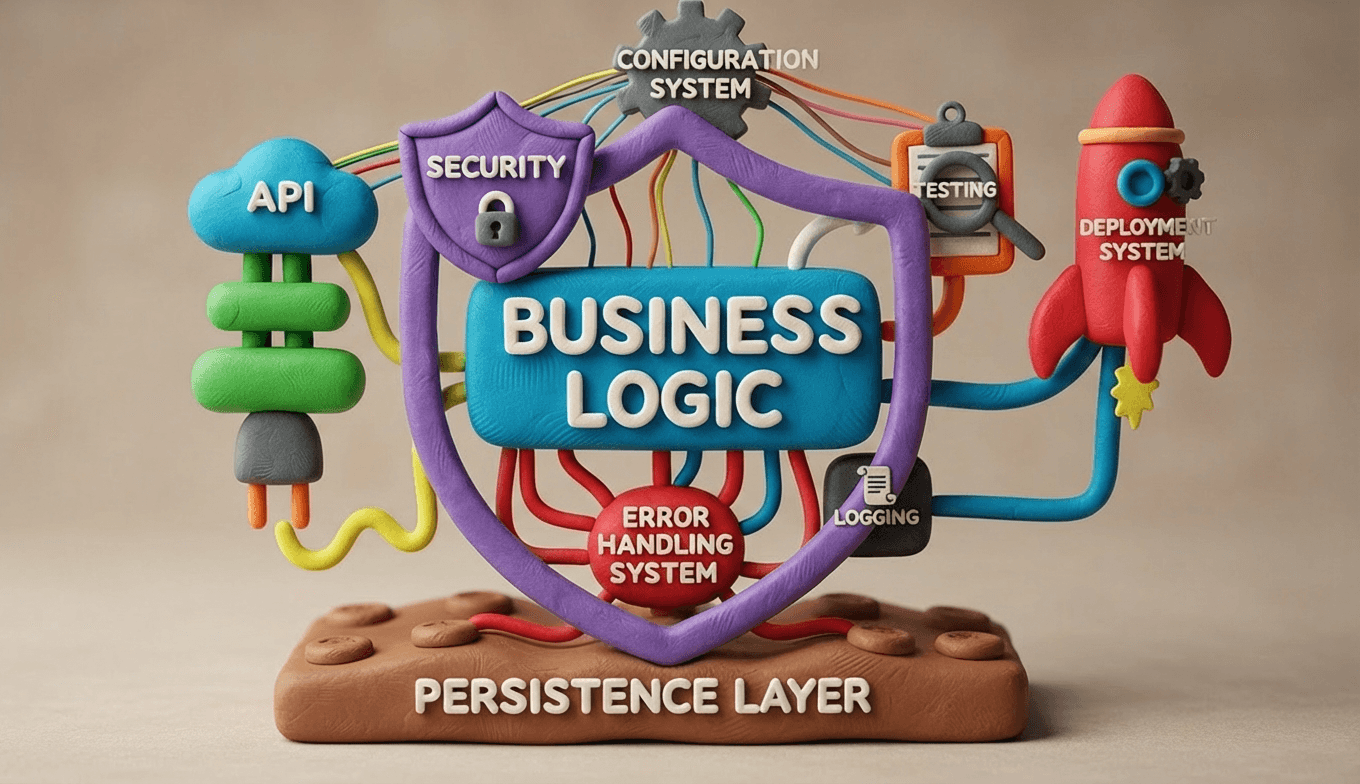
Modular Architecture as Control: Essential Modules and AI-Assisted Development Methodologies
Abstract
As AI agents become capable of generating code at scale, the challenge of software development shifts from writing code to controlling what gets written. This paper argues that modular architecture serves as the primary control mechanism, and identifies the essential modules that constitute well-architected software systems. We propose methodologies for designing and building large applications where humans specify modular architecture and AI agents perform implementation. ##Introduction The emergence of capable AI coding agents creates both opportunity and risk. The opportunity: dramatically accelerated development cycles and reduced implementation burden. The risk: loss of control, where AI-generated code becomes an impenetrable tangle that humans can neither understand nor maintain. The solution lies in rigorous modular specification. When modular architecture is properly defined, it serves as both a blueprint for AI agents and a control mechanism for human developers. ##Essential Modules of Software Systems Regardless of domain or scale, well-architected software systems consistently comprise several fundamental module types. Understanding these is prerequisite to effective architectural control.
- Data Persistence Layer This module manages all interaction with persistent storage—databases, file systems, object stores. Its responsibilities include data access, transaction management, caching strategies, and data integrity enforcement. A well-specified data layer isolates the rest of the system from storage implementation details, allowing databases to be swapped or scaled without touching business logic.
- Business Logic Core The business logic module encapsulates domain rules, processes, and workflows. It should be independent of how data is stored or how users interact with the system. This is where the "what" of the application lives—what rules govern transactions, what validations must be enforced, what workflows must be orchestrated. Properly isolated business logic can be tested independently and remains stable even as interfaces and infrastructure evolve.
- API and Interface Layer This module defines how external actors—whether human users, other services, or third-party integrations—interact with the system. It includes REST APIs, GraphQL endpoints, message queue interfaces, and user interface components. The interface layer translates external requests into internal operations and formats internal responses for external consumption. Clean separation here enables multiple interfaces to the same business logic.
- Authentication and Authorization Security concerns—verifying identity and controlling access—must be isolated into dedicated modules. This includes user authentication, token management, permission systems, and role-based access control. Centralizing these concerns ensures consistent security policy enforcement and enables security updates without touching business logic.
- Configuration and Environment Management Applications behave differently in development, testing, and production environments. Configuration modules manage environment-specific settings, feature flags, and runtime parameters. Proper configuration management prevents environment-specific details from leaking into business logic and enables the same codebase to run in multiple contexts.
- Observability Infrastructure Logging, metrics, tracing, and monitoring constitute the observability module. This is how we understand what a running system is doing. Well-designed observability infrastructure operates independently of business logic, using aspect-oriented or middleware patterns to capture system behavior without cluttering core functionality.
- Testing and Verification Framework Testing infrastructure is itself a module—or rather, a set of modules. Unit test harnesses, integration test frameworks, end-to-end test suites, and performance testing tools all require specification. Testing modules validate that other modules comply with their specifications, making them the enforcement mechanism for architectural control.
- Deployment and Orchestration Deployment modules manage how code moves from development to production. This includes containerization, orchestration (Kubernetes, etc.), CI/CD pipelines, and infrastructure-as-code. Separating deployment concerns from application logic enables independent evolution of deployment strategies.
- External Service Integration Most applications integrate with external services—payment processors, email providers, cloud services, third-party APIs. Each integration should be wrapped in an adapter module that translates between the external service's interface and the application's internal model. This isolates the application from external changes and enables swapping service providers.
- Error Handling and Recovery Error handling strategies—how exceptions are caught, logged, and recovered from—should be architecturally consistent. Error handling modules define error taxonomies, recovery strategies, and user-facing error experiences. Centralizing error handling prevents inconsistent error responses and enables systematic reliability improvements.
Methodologies for AI-Assisted Development
With essential modules identified, we can now define methodologies for building large applications where AI agents write code under human architectural control.
Specification-First Development
The foundational methodology: humans write detailed module specifications before any code is generated. Each specification defines: • Purpose and Responsibilities: What this module does and does not do • Interface Contracts: Function signatures, API endpoints, message formats • Dependencies: What other modules this module requires • Data Models: Structures this module operates on • Error Conditions: How this module handles and reports errors • Performance Requirements: Latency, throughput, resource constraints • Testing Criteria: How to verify this module works correctly Only when specifications are complete and reviewed do AI agents begin code generation. The specification serves as both instruction to the AI and acceptance criteria for its output.
Contract-Driven Development
Interfaces between modules are the critical control points. In contract-driven development, all module interfaces are defined first, using interface definition languages (IDLs), API specifications (OpenAPI/Swagger), or type systems. These contracts are: • Machine-Readable: AI agents can parse and verify compliance • Versioned: Interface evolution is tracked and managed • Tested: Contract tests verify both sides of each interface • Documentation: Contracts serve as authoritative interface documentation With contracts established, modules can be implemented independently by different AI agents in parallel, with confidence that they will integrate correctly.
Hierarchical Decomposition
Large applications must be decomposed hierarchically. The methodology: 1. High-Level Architecture: Humans define the top-level module structure and their interactions 2. Interface Specification: Humans specify contracts between top-level modules 3. Recursive Decomposition: Each module is decomposed into sub-modules, with AI assistance 4. Terminal Implementation: When modules are sufficiently simple, AI agents implement them fully At each level, humans review and approve the decomposition before proceeding deeper. This ensures architectural control is never ceded—humans always understand the system at a level of abstraction they can reason about.
Test-Specified Development
Traditional test-driven development (TDD) has developers write tests before implementation. For AI-assisted development, we extend this: 1. Specification Tests: Humans write tests that verify module specifications are met 2. Interface Tests: Contract tests verify interface compliance 3. AI Generation: AI agents generate code to pass these tests 4. Verification: Generated code is verified against tests 5. Refinement: Failing tests trigger AI regeneration with additional constraints Tests become the mechanism for communicating requirements to AI agents. A comprehensive test suite is effectively an executable specification.
Incremental Integration with Verification
Rather than having AI agents generate entire systems, development proceeds incrementally: 1. Core Module First: Implement and verify the business logic core 2. Add Adjacent Modules: Implement modules that depend on verified modules 3. Integration Testing: At each step, verify integration with existing modules 4. Continuous Verification: Regression tests run on every addition This methodology prevents cascading errors. If an integration fails, the problem is isolated to the most recently added module.
Human Review Gates
Not all architectural decisions can be specified in advance. The methodology must include explicit human review gates: • Architecture Review: Before decomposition proceeds to next level • Interface Review: Before contracts are finalized • Implementation Review: Before AI-generated code is merged • Security Review: Before modules handling sensitive data or operations are deployed • Performance Review: Before modules with stringent performance requirements are accepted These gates are where human judgment supplements formal specifications.
Pattern Libraries and Reference Implementations
To guide AI agents toward consistent, high-quality implementations: 1. Maintain Pattern Libraries: Documented design patterns with reference implementations 2. Specify Pattern Usage: In module specifications, indicate which patterns apply 3. AI Training: Ensure AI agents are familiar with the pattern library 4. Pattern Verification: Tests verify generated code follows specified patterns This creates consistency across AI-generated code and reduces the need for detailed implementation specifications.
Iterative Refinement with Constraints
Initial AI-generated implementations rarely satisfy all requirements. The methodology: 1. Generate: AI produces initial implementation from specification 2. Verify: Automated tests and static analysis evaluate the implementation 3. Identify Gaps: Failed tests, performance issues, or style violations are catalogued 4. Refine Specification: Specifications are enhanced with additional constraints 5. Regenerate: AI produces new implementation incorporating new constraints 6. Repeat: Until all requirements are satisfied This iterative process progressively tightens specifications until generated code meets all criteria.
Modular Versioning and Evolution
Applications evolve. The methodology must handle change: • Version Modules Independently: Each module has its own version • Specify Compatibility: Define which module versions work together • Deprecation Paths: Plan how interfaces evolve without breaking dependents • AI-Assisted Migration: When interfaces change, AI agents update dependent modules This enables continuous evolution while maintaining architectural control.
Conclusion
The transition to AI-assisted software development does not eliminate the need for human expertise—it elevates it. Humans shift from writing code to architecting systems, from implementing functions to specifying modules, from debugging syntax to designing interfaces. The essential modules identified here—data, business logic, interfaces, security, configuration, observability, testing, deployment, integration, and error handling—provide the framework for architectural thinking. The methodologies proposed—specification-first, contract-driven, hierarchical decomposition, test-specified, incremental integration, human review gates, pattern libraries, iterative refinement, and modular versioning—create a development process where humans maintain control through architectural decisions while AI agents handle implementation details that follow logically from those decisions. This is why "Modularity" is the right name. It represents not just a design principle but a development paradigm: one where properly specified modular architecture serves as the control mechanism for AI-assisted software development, enabling humans and machines to collaborate effectively in building complex systems.